
Release peace: the magazine
Release peace: the magazine
Analysis & Background Stories on International Affairs
Canada, Your History: The Earl of Dalhousie and the Context of John Elliott Woolford's Famous Paintings
Written by: Elora Copeland
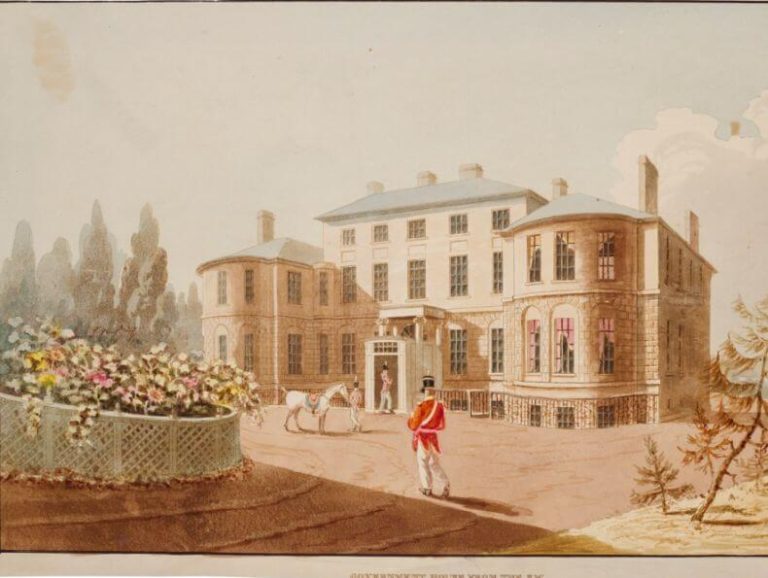

depicted painting: Halifax, 1819 by J.E. Woolford
This article was published as part of a collaboration with Saint Mary’s University in Halifax, Canada. It is generously supported by the SMU Alumni fund.
A Soldier turned Draughtsman: Woolford meets Dalhousie
John Elliott Woolford’s artistic abilities first caught the eye of George Ramsay, 9th Earl of Dalhousie, during the British Expedition to Egypt in 1800. Woolford served with the British army as a private soldier, with Dalhousie as his commanding officer. During their service, Dalhousie would order Woolford to sketch the landscape and key moments of the campaign. Following the end of the campaign, Woolford was invited to stay with Dalhousie at his castle in Scotland. There, Woolford further developed his artistic talent and created The Egyptian Album, a collection of watercolour paintings inspired by his sketches of Egypt. In 1816, Dalhousie became the Lieutenant Governor of Nova Scotia and invited Woolford to work for him as his official draughtsman. Through the artwork and maps he was commissioned to create, Woolford produced eye-catching depictions of Nova Scotia, but there is more to his work than meets the eye.
How Art Intertwined with Dalhousie’s Settler-Colonial Goals
Dalhousie had an interest in visually commemorating his colonial endeavors and sought to continue doing so during his time as Lieutenant Governor of Nova Scotia. Through his personal writings, Dalhousie revealed that he was avidly motivated to witness settler colonialism unfold in Nova Scotia. Dalhousie wanted to document his project and time there, hence commissioning Woolford to sketch it all. Moreover, the art that Dalhousie commissioned not only recorded the British colonial project in Nova Scotia but also helped promote it. In “Picturesque Canada” (1882), George Monro Grant, the most important Principal of Queen’s University (Ontario), argued that art can aid in stirring nationalism and the destined “development of the nation”.
Woolford’s Work
Woolford and Dalhousie travelled across Nova Scotia between 1816-1820, occasionally crossing over to New Brunswick as well. Woolford officially finished working for Dalhousie in 1821, and by then had produced 344 known sketches and numerous paintings for his patron, contributing to Dalhousie’s personal collection. This collection contained many works, produced by various artists, of the most populous areas that Dalhousie had governed. Woolford greatly contributed to this collection. For instance, one volume of Woolford’s work, from 1817, contained over one hundred sketches of Nova Scotia. These included sketches that Woolford made of Halifax, where Dalhousie resided during his time as Lieutenant Governor.
Dalhousie’s Direction
Woolford’s works were impressive, but Dalhousie played a direct part in their creation since he had significant influence over the subject matter depicted in the art and the maps that Woolford created of Nova Scotia. As the patron, Dalhousie frequently selected the scenes which Woolford was to paint or sketch, as well as the way in which they were depicted. Dalhousie admitted in his writings to directing Woolford’s works. Art historian René Villeneuve notes that, upon the works of Woolford that Dalhousie owned, Dalhousie’s writing is often present “on the mounting or verso of those [watercolours] he owned”.
The Surveys and Maps of Nova Scotia
The selection of the surveys’ and maps’ subject matter is also thought to have been influenced by Dalhousie’s settler colonial agenda. Woolford’s surveys of the two Great Roads were designed to showcase what traversing these two roads would be like circa 1818. These surveys illustrated a shift in the colony’s environment from wilderness to domesticated, as British settlers began to settle along these roads. Moreover, their cartographic representation demonstrated the progression of settler colonialism in Nova Scotia. The surveys, however, lacked an accurate scale. Woolford was interested in combining romantic drama with the actual spaces that he depicted in his art and maps. This meant that the mapping and scaling of the landscapes were not precise, but rather idealized, producing a romanticized record of Dalhousie’s settler colonial project in Nova Scotia.
The Non-Depiction of Indigenous Nations
Dalhousie’s settler colonial intentions influencing Woolford’s work are further evident in the erasure of Indigenous presence from surveys. Nova Scotia was, and remains today, part of the Mi’kma’ki, the unceded territory of the Mi’kmaw people. The surveys of the two Great Roads, however, lacked any indication of this Indigenous presence. By contrast, the family names of British settlers who lived along these roads were referenced on the maps. Through the maps that Woolford illustrated, he constructed Nova Scotia as devoid of non-British inhabitants and attempted to depict Dalhousie’s settler colonial vision as a reality.
A Successful Pair
During his time as Lieutenant Governor, Dalhousie significantly advanced the colonial development of Nova Scotia. Dalhousie’s vision for settler colonial advancement extended from Nova Scotia to British North America once he became the Governor General of the country in 1820. Viewing British North America as a country under construction, Dalhousie continued to commission various artists to create a record of it. Next to Woolford, notable artists commissioned by Dalhousie include Charles Ramus Forrest, James Pattison Cockburn, James Smillie, and John Crawford Young. After Woolford had finished working for Dalhousie in 1821, their career paths diverged, and so the two went their separate ways. Dalhousie moved to Québec City, whilst Woolford headed to Fredericton, New Brunswick. Unique to his time there, Woolford spent his days working primarily as an architect and went on to win competitions for his plans for King’s College and Fredericton’s Government House.
How Dalhousie Continued to Color Woolford’s Career
In 1823, Dalhousie helped Woolford secure the position of assistant barrack-master in Saint-John, New Brunswick. It was not long before Woolford was promoted to barrack-master in Fredericton, a position he held until his retirement in 1859. Today, Dalhousie is commemorated as being one of the first key patrons of Canadian art, and among all the artists he hired, Dalhousie commissioned Woolford the most. Moreover, Woolford’s most productive years as an artist are recognized as those in which he worked for Dalhousie in Nova Scotia. Dalhousie not only molded the works Woolford was commissioned to create but also the impressions the British had of the land that was depicted in them.
