
Release peace: the magazine
Release peace: the magazine
Analysis & Background Stories on International Affairs
Where History Went Wrong: A Review of De-Ba'athification in Iraq Post-2003
Written by: Sarah Qanbar
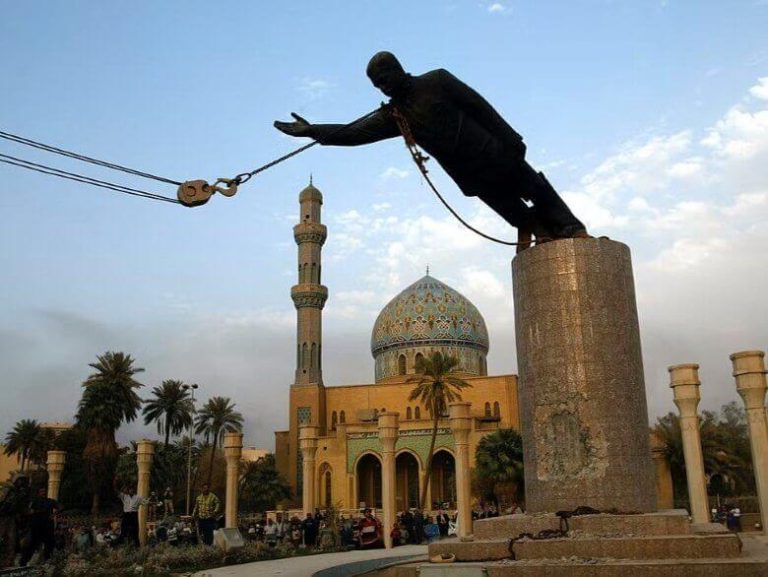
image credit: unknown service member of the U.S. Army
This article was published as part of a collaboration with the Department of Political Science of the University of Colorado Denver. Any opinions expressed do not necessarily reflect the views of the university or of Release Peace.

Reforms with Unintended Consequences
The 2003 U.S.-led invasion of Iraq ended Saddam Hussein’s authoritarian rule and was followed by efforts to rapidly transform the state and country. Saddam Hussein’s party that had ruled the country uninterruptedly for 35 years was called the Ba’ath Party. Two of the most transformative reforms after 2003 were the de-Ba’athification, imposed through Coalition Provisional Authority (CPA) Order No. 1 in May 2003 by the US-led provisional authorities, and federalism, formalized in the 2005 Iraqi Constitution. These measures were introduced to prevent a return to dictatorship and to create a decentralized, democratic political system. The architects of the reforms believed that removing Ba’athist influence and distributing authority among Iraq’s diverse communities would lay the foundation for a peaceful future. Instead, the sudden policy shifts weakened state institutions, deepened social divisions, and triggered violent power struggles that still shape Iraq’s governance two decades later.
De-Ba’athification: Removing the Regime Through Removal of the State
De-Ba’athification was intended to achieve a clean break from the former dictator’s rule, but it was implemented without mechanisms to preserve the basic functionality of the state. Under Ba’athist Iraq, party membership was a prerequisite for jobs in government, higher education, and the military. CPA Order No. 1 removed anyone holding a senior Ba’ath Party rank. However, the policy was expanded so broadly that approximately 85,000 civil servants and around 400,000 soldiers lost their jobs almost immediately. Ministries whose work affected aspects of everyday life, from power plants to public records, lost their only experienced administrators. Hospitals lacked trained staff, and schools struggled to open. Core governance was disrupted at the exact moment Iraqis needed stability.
Fueling Insurgency and Insecurity
The disbanding of the Iraqi army was especially catastrophic. Most soldiers were not political loyalists but individuals who had joined to make a living. When suddenly fired, many lost pensions, livelihoods, and dignity. The journal article “The Consequences of De-Ba’athification in Iraq” argues that this mass dismissal directly contributed to the rise of insurgency groups like Al-Qaeda in Iraq, as many former Sunni officers, equipped with military skills and feeling deliberately targeted, joined armed resistance against the new state.
Attempts at Fixing the Damage
The CPA later attempted to soften the policy through Memorandum No. 1, which allowed low-ranking Ba’athists to appeal for reinstatement. But by that point, De-Ba’athification had shifted from transitional justice into a political weapon. New elites could accuse rivals of Ba’athist affiliation to push them out of power. This fostered sectarian rivalry, especially between Sunni and Shia parties competing for dominance in the new government. Public trust eroded as people saw state employment tied to factional loyalty rather than merit. De-Ba’athification had begun as an attempt to achieve accountability but resulted in hollowing out state capacity and creating lasting institutional trauma.
Federalism: A Promise of Fair Representation
The other great overhaul of the state was to move the country from a centralized system governed out of Baghdad to a federalized state that took into account the ethnic and sectarian diversity across Iraq. Most prominently, the Kurdistan Regional Government (KRG) received formal recognition of its autonomous powers, including control of the Peshmerga armed forces. Iraq’s provinces expected similar empowerment and believed decentralization would democratize decision-making. This policy responded to Iraq’s historical experiences with centralized repression and reflected international hopes for a pluralistic system.
Legal Ambiguity and Economic Conflict
In the case of Kurdistan, key sections of the 2005 Iraqi Constitution left the exact responsibilities of the KRG vis-à-vis the government in Baghdad undefined. Crucially, there was no clear system for sharing oil revenue, which funded an estimated 90% of the national budget. The KRG pursued independent oil contracts and exports, while Baghdad insisted that only the federal government could regulate natural resources. Both interpreted the constitution in their favor, turning resource wealth into a permanent political battleground. In years of dispute, oil pipelines were shut down, federal budget transfers to Kurdistan were delayed, and civil servants went months without salaries.
“Uneven Governance and Patronage”
Analysts from the Center for a New American Security (CNAS) argue that Iraq’s federal system developed into an “uneven” form of federalism, where only the Kurdistan Region enjoys autonomy while the remaining provinces remain largely dependent on Baghdad for authority and financial resources. This imbalance fuels competition rather than cooperation, as regions without autonomy struggle to gain influence and access to state budgets. Local administrations often lack the professional experience needed to manage their expanded responsibilities, creating opportunities for political elites to dominate decision-making. Instead of decentralization empowering citizens, it allowed regional powerbrokers to use public jobs and government contracts as tools of patronage, further weakening transparency and accountability across Iraq’s political landscape.
Collision of Reforms
While federalism required strong institutions at both national and local levels, De-Ba’athification removed the very personnel who could have provided continuity. The result was a power structure full of authority on paper but lacking administrative capability in practice. An assessment from the U.S. Department of Justice, “Failing Oversight: Iraq’s Unchecked Government” explains how this vacuum allowed militias and party networks to infiltrate state agencies. Citizens often relied on armed groups or informal intermediaries, rather than the government, to access basic services.
Enduring Fragmentation
The Peacemakers Network’s report “Iraq after the Territorial Defeat of Islamic State” notes that even after ISIS was largely defeated, disputes over the control of provinces such as Kirkuk, conflicts over the federal budget, and overlapping security forces have prevented long-term stabilization. Instead of one national political system, Iraq now operates through competing jurisdictions that complicate coordination and weaken policy implementation. Decisions are seen as bargaining processes rather than coherent governance.
Implications from Iraq’s Post-Conflict Experience
Iraq’s post-2003 experience demonstrates how reforms designed to fix authoritarianism were able to reproduce instability by being rushed and externally imposed. Removing political elites without transitional planning erased the institutional memory required to deliver essential public services. Similarly, transferring power without a strong national structure deepened fragmentation rather than empowering local communities. In Iraq, the combination of these approaches created a decentralized landscape without cohesive oversight or capable institutions of government.
Two decades later, Iraq still grapples with the consequences: public frustration with government performance, inequitable resource distribution, and continued tension between Baghdad and regional authorities. Rebuilding trust in Iraq has demanded strengthening state capacity, clarifying constitutional authority, and ensuring that governance structures serve citizens rather than political blocs. Ultimately, the early decisions made during Iraq’s transition remain a central factor shaping the country’s political future today.
